

Science Up Close: Researchers’ Night at BrainVisionCenter

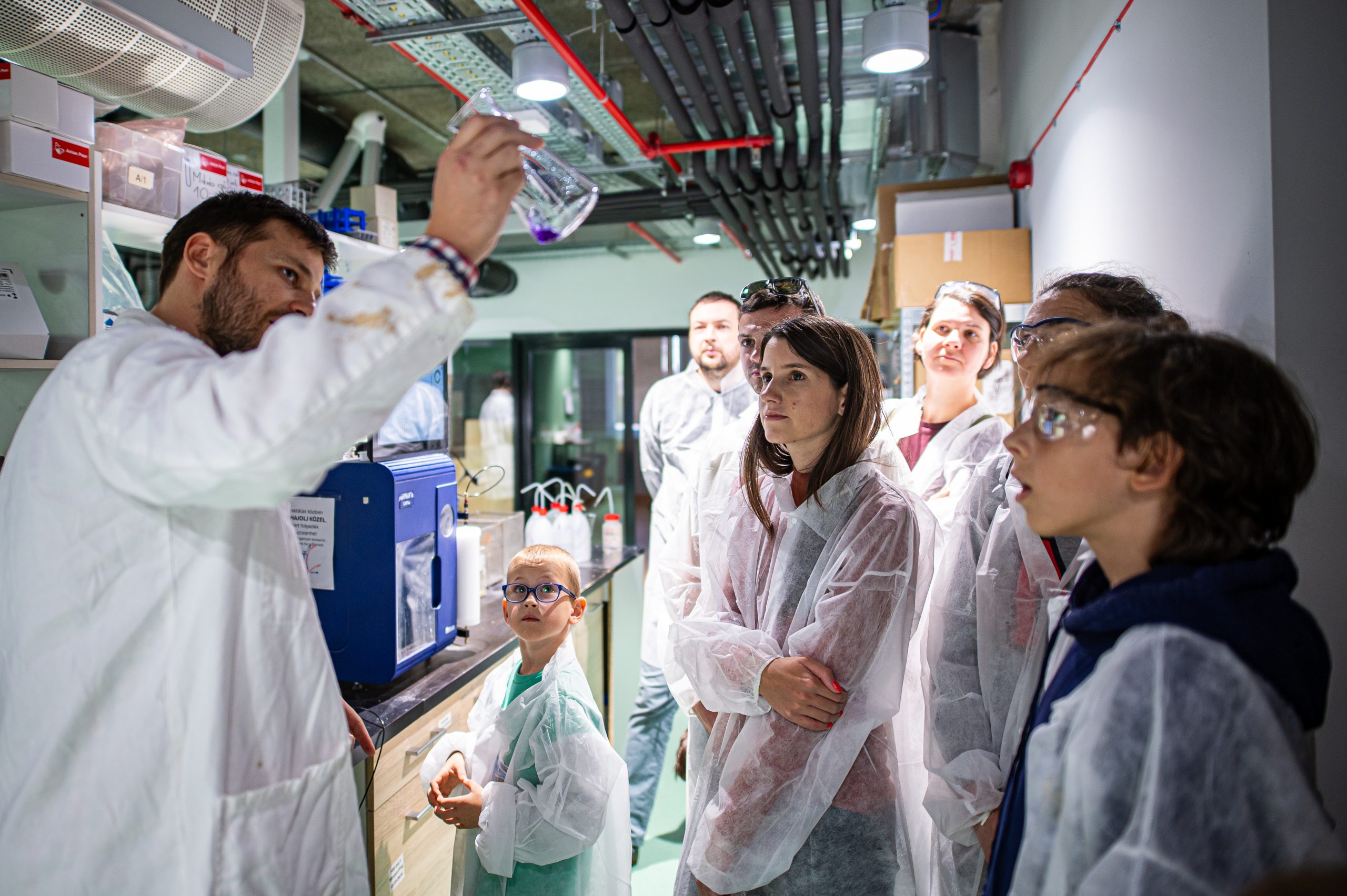
Eye-catching experiments, extraordinary microscopes, glowing brain cells and the mysteries of vision welcomed visitors to this year’s Researchers’ Night at BrainVisionCenter. Once again, the event offered guests of all ages a glimpse into the research carried out at our Institute.


“It is truly impressive to see the collaboration and enthusiasm of the Institute’s team,” wrote one of our adult visitors after the event. For one 8-year-old visitor, the mouse experiments were the highlight of the evening: “What I liked best was when they explained what the mouse does and how they examine them.”

Throughout the evening, visitors had the opportunity to discover hidden features of banknotes and passports revealed under UV light, experiment with “invisible ink”, and explore various phosphorescent materials presented by the Department of Biological Chemistry.

At the Department of Biology, guests could learn more about mouse experiments, see a room-sized microscope and glowing brain cells, and gain a glimpse into the fascinating mechanisms of vision.

We would like to thank everyone who joined us, as well as our colleagues whose work made the evening possible. We hope to welcome you again at next year’s Researchers’ Night!

Balázs Rózsa presents AI-driven advances in brain research at AI Summit 2026

Artificial intelligence is becoming an increasingly important tool in neuroscience, enabling researchers to analyse complex datasets, identify neural structures and perform measurements at a scale that would previously have been impossible.

At AI Summit 2026 in Budapest, Balázs Rózsa, founder and Scientific Director of BrainVisionCenter, presented some of the latest developments at the intersection of artificial intelligence, neurophotonics and brain research.

Among the technologies highlighted during his presentation was BVC’s latest 3D laser microscopy system for freely moving animals. Combining high-precision optical measurements with real-time tracking and AI-based data processing, the system enables researchers to investigate neural activity while preserving natural movement and behaviour.

AI plays a key role in automatically identifying neurons and planning efficient scanning trajectories, helping the system measure and activate more than 10,000 neurons simultaneously.

The presentation and the research behind these developments were recently featured by Economx, which also explored their potential applications in understanding neural networks and developing new approaches to vision restoration.

Read the full Economx article HERE!