A Glimpse into the World of Research – High School Students Visit the BrainVisionCenter

The Faculty of Science at Eötvös Loránd University launched the “Talentum Program” in September 2022, offering high school students interested in the natural sciences a unique opportunity to explore a potential career in research. 

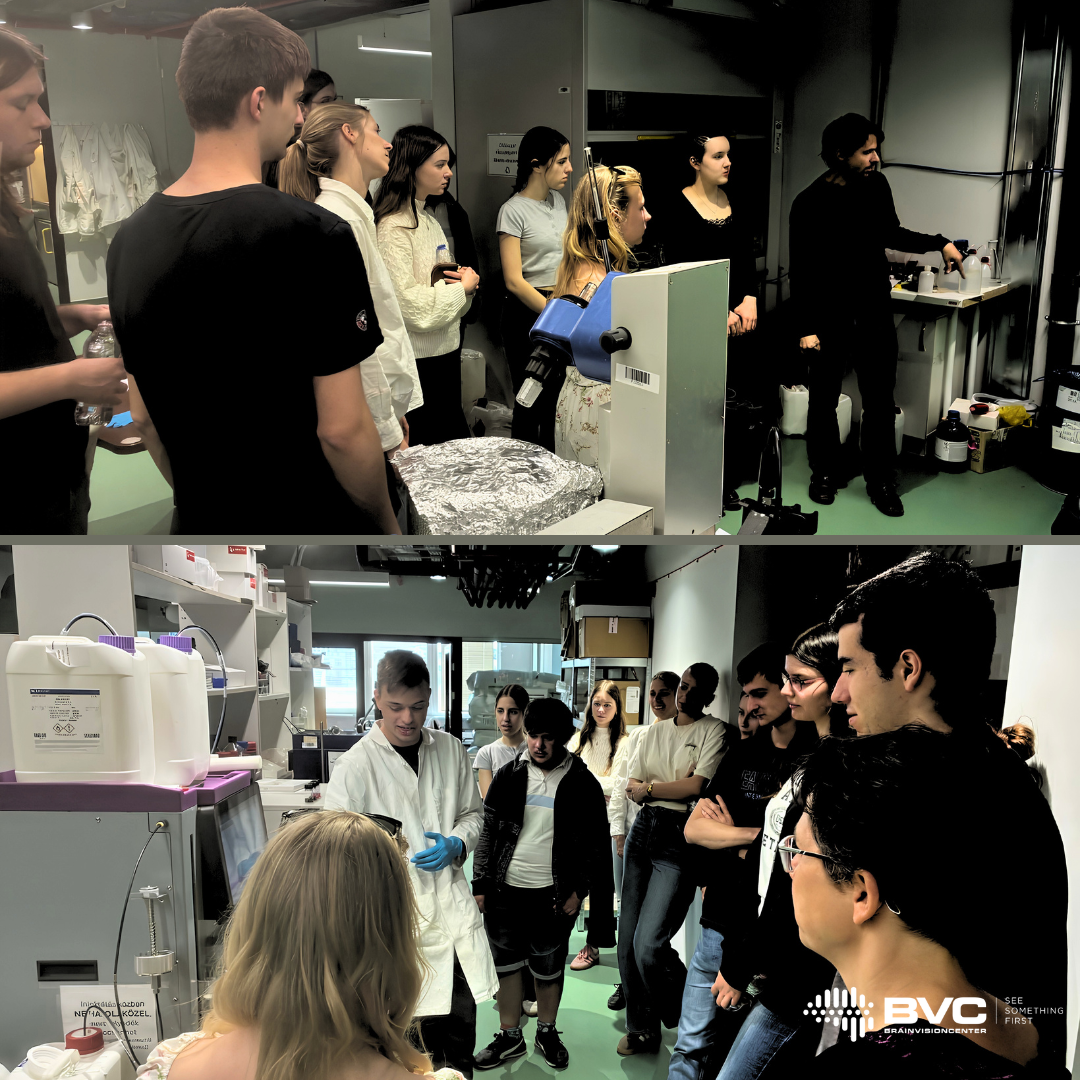
Beyond theoretical training, the program provides students with first-hand insight into some of Hungary’s leading research institutes. As part of this initiative, our institute recently welcomed a group of highly motivated students with a strong interest in chemistry and biology. 

During their visit, our colleagues introduced them to our cutting-edge methodologies and state-of-the-art equipment-many of which represent world-class innovations in neuroscience research. The students gained a direct glimpse into how advanced scientific work is conducted in an internationally recognized research environment. 

The experience proved to be highly inspiring, as reflected in their feedback: 

“It was fantastic to see such instruments in operation.”
“I was surprised by how many young researchers are working here with such dedication.”
“I wouldn’t have thought that such high-quality work is carried out at a domestic research institute.” 

We believe that encounters like these play a key role in motivating the next generation of scientists and fostering long-term interest in scientific careers. 
Another PhD success strengthens BrainVisionCenter’s scientific community

At BrainVisionCenter, an increasing number of our colleagues are earning scientific degrees day by day, continuously strengthening the professional and research excellence of our Institute. 

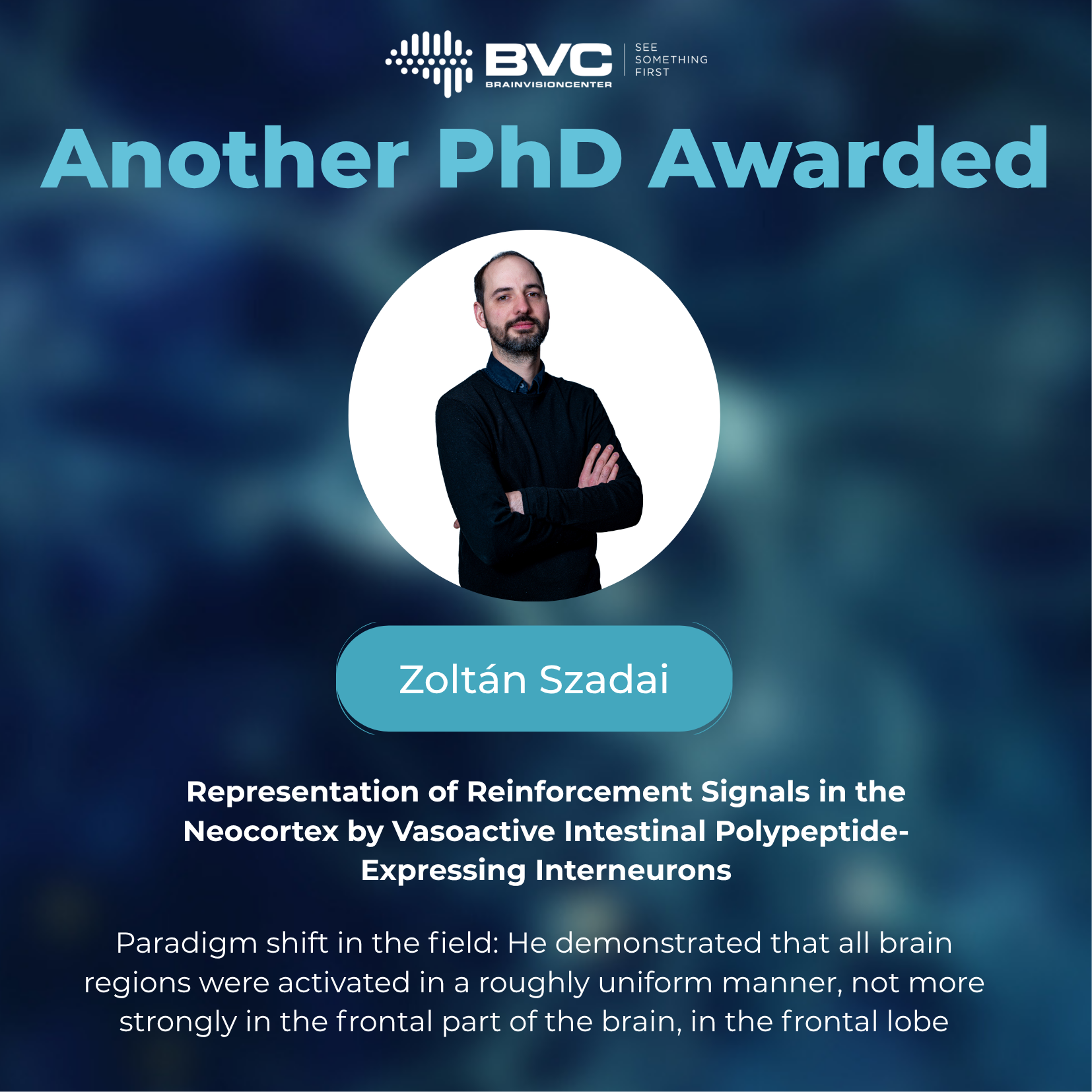
We are proud to share that Zoltán Szadai has successfully defended his PhD. 

His research, titled “Representation of Reinforcement Signals in the Neocortex by Vasoactive Intestinal Polypeptide-Expressing Interneurons,” has been described as groundbreaking by the doctoral committee. 

The study offers important new insights into how learning-related signals are represented in the brain. As highlighted by his supervisor, Balázs Rózsa: 

“The committee was very surprised by the findings, as-like the rest of the world-they expected that during learning, the global ‘teaching’ signal we described, which ascends from deeper brain regions to initiate learning, would appear more strongly in the frontal part of the brain, in the frontal lobe. In contrast, Zoltán Szadai’s research demonstrated that all brain regions were activated in a roughly uniform manner. This represents a paradigm shift in the field.” 

These findings challenge long-standing assumptions in neuroscience and may reshape how we understand the neural mechanisms of learning. 

We congratulate Zoltán on this outstanding achievement and wish him continued success in his scientific career. 

The Role of Artificial Intelligence in the Future of Research – BVC at the IEEE AI Summit

Artificial intelligence plays an increasingly important role in both the strategic direction and day-to-day operations of the BrainVisionCenter. Beyond opening new frontiers in neuroscience, AI significantly accelerates research workflows from data acquisition to analysis and interpretation. 

These topics were addressed by Balázs Rózsa, Founder and co-owner of BVC, at the recent IEEE Central European AI Summit, hosted by Óbudai University. 

In his talk, he explored key questions such as: 

  • how artificial intelligence facilitates scientific research,  
  • how it shortens analysis processes,  
  • and what role it plays in data collection and processing.  

The summit brought together leading domestic and international experts from academia, industry, innovation, and regulatory sectors. Participants showed strong interest in BVC’s AI-driven research activities, raising numerous insightful questions, and engaging in dynamic discussions. 

We are proud that BrainVisionCenter integrates diverse scientific expertise to advance AI-based research and development. By leveraging these technologies, we aim to further accelerate discoveries in neuroscience and support their translation into real-world applications.