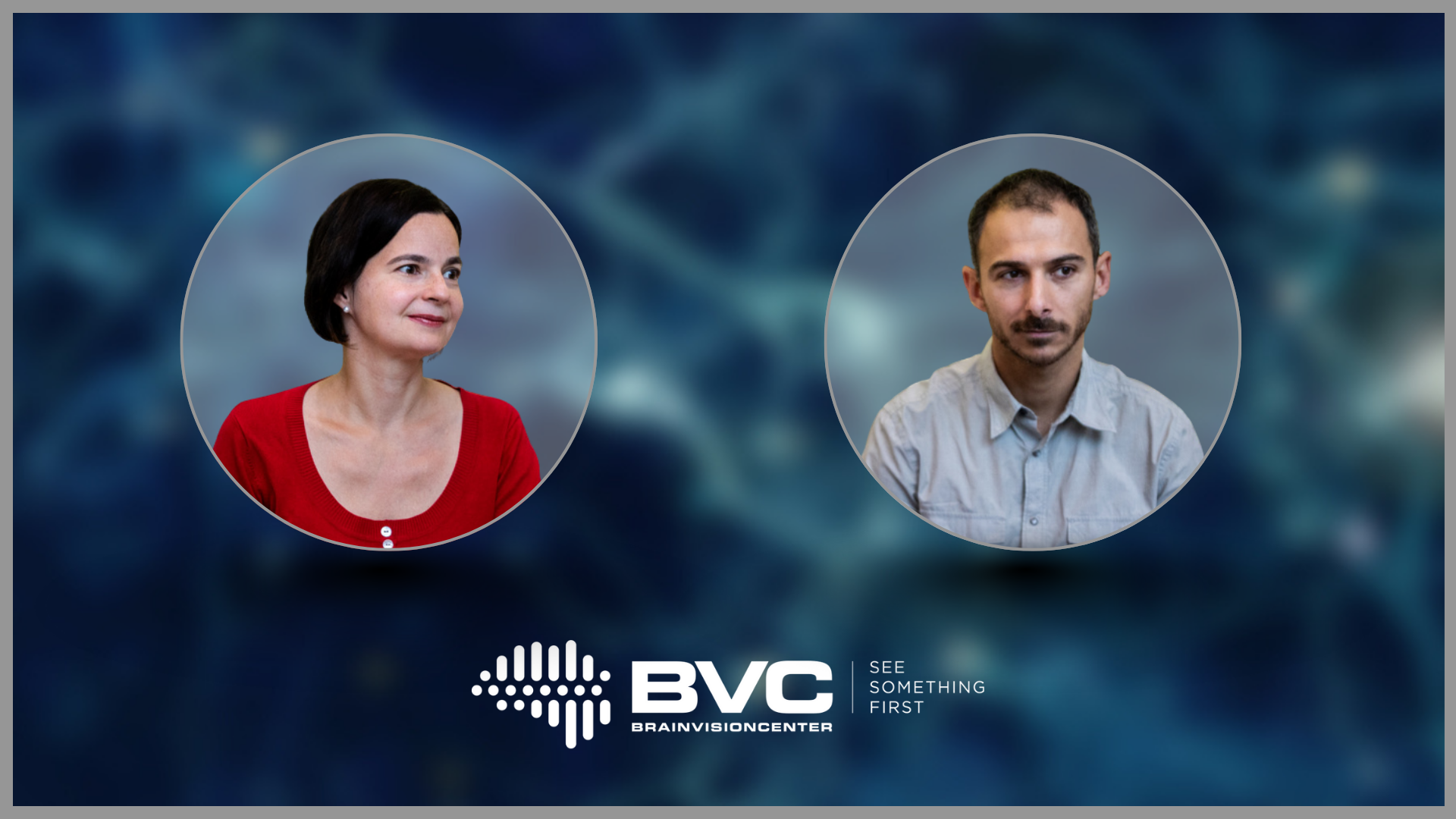
Nóra Lenkey and Máté Neubrandt, a young researcher couple who began their scientific careers at the Institute of Experimental Medicine, returned to Hungary after seven years at the University of Oslo to join BrainVisionCenter. Their work focuses on understanding how mice navigate and learn in both familiar and entirely new environments. Using a virtual reality system, mice run on a foam wheel while moving through colorful, computer-generated corridors displayed on monitors. This setup allows researchers to observe how internal spatial maps form in the hippocampus and how specific neuronal cell types influence an animal’s ability to orient itself, discover rewards, and adapt to novel surroundings. Their findings highlight the essential role of these cells in spatial navigation, suggesting parallels in human brain function.
BrainVisionCenter provides a unique environment where microscopy development, biological experiments, molecular tools, and chemical innovations are integrated, enabling rapid transitions from new concepts to practical applications. One of the center’s newest tools is a robot-arm–based microscope capable of following a freely moving mouse in real time, making it possible to perform high-resolution imaging during natural behavior and expanding the range of behaviors that can be studied under realistic conditions.
Nóra joined the epilepsy research group, which is developing a diagnostic method to precisely locate seizure-generating brain regions during surgery by imaging neuronal activity at the level of individual cells. This approach may enable surgeons to identify the exact cells involved in epileptic activity and potentially eliminate them with focused laser pulses, minimizing tissue loss and preserving critical brain functions. The method has already been validated in mice, and its publication is underway.
Their decision to return home was influenced by the scientific vision of the center, the opportunity to collaborate closely with engineers and developers, and the dynamic, translational research environment. On a personal level, they valued being closer to family, especially for their two young daughters, and found it difficult to fully integrate socially in Norway due to cultural distance. In Budapest, they appreciate the ease of forming connections and the familiar sense of community.