
Technology Overview
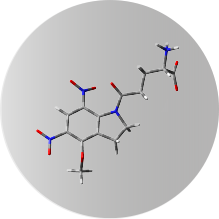
This dinitro-indoline-masked form of glutamate releases the bioactive glutamate more rapidly than any other commercially available compound. It was developed for high-quantum yield requiring less irradiation for release, so its effective concentration is lower than other caging scaffolds. The caged compound exists as trifluoroacetic acid salted form (DNI-Glu*TFA) ensuring good solubility, stability and low hygroscopicity. DNI-Glu is a compound developed in-house.
See more at Uncaging.
Features
- Photostimulation with two-photon laser
- High quantum-yield
- Effective at low concentration
- Seven-fold higher quantum yield than any other caged form
- Stable and soluble
- Primarily used for in vitro experiments
Benefits
-
- High excitatory postsynaptic potential and high Ca2+ transient as a response to the photo release
- Less illumination is sufficient to elicit the same response as with alternative compounds
- Elicits large transients or regenerative activity
- Applicable for receptor mapping experiments
Please send an email to sales@brainvisioncenter.com to request a quotation.
References
- Endocannabinoid Signaling Mediates Local Dendritic Coordination between Excitatory and Inhibitory Synapses.
Hai Yin Hu, Dennis L.H. Kruijssen, Cátia P. Frias, Balázs Rózsa, Casper C. Hoogenraad, Cell Reports (2019)
- A compact holographic projector module for high-resolution 3D multi-site two-photon photostimulation.
Mary Ann Go, Max Mueller, Michael Lawrence Castañares, Veronica Egger, Vincent R. Daria, PLOS One (2019)
- Coincidence Detection within the Excitable Rat Olfactory Bulb Granule Cell Spines.
S. Sara Aghvami, Max Müller, Babak N. Araabi and Veronica Egger, J. Neurosci. (2019)
- Voltage Gated Calcium Channel Activation by Backpropagating Action Potentials Downregulates NMDAR Function
Anne-Kathrin Theis, Balázs Rózsa, Gergely Katona, Dietmar Schmitz and Friedrich W. Johenning, Front. Cell. Neurosci. (2018)
- High efficiency two-photon uncaging coupled by the correction of spontaneous hydrolysis.
Dénes Pálfi, Balázs Chiovini, Gergely Szalay, Attila Kaszás, Gergely F. Turi, Gergely Katona, Péter Ábrányi-Balogh, Milán Szőri, Attila Potor, Orsolya Frigyesi, Csilla Lukácsné Haveland, Zoltán Szadai, Miklós Madarász, Anikó Vasanits-Zsigrai, Ibolya Molnár-Perl, Béla Viskolcz, Imre G. Csizmadia, Zoltán Mucsi and Balázs Rózsa, Org. Biomol. Chem. (2018)
- Super-Resolution Imaging of the Extracellular Space in Living Brain Tissue
Jan Tønnesen, V.V.G. Krishna Inavalli, U. Valentin Nägerl, Cell (2018)
- Imaging membrane potential changes from dendritic spines using computer-generated holography.
Dimitrii Tanese, Ju-Yun Weng, Valeria Zampini, Vincent de-Sars, Marco Canepari, Balazs J. Rozsa, Valentina Emiliani, Dejan Zecevic, Neurophotonics (2017)
- Cell-type–specific inhibition of the dendritic plateau potential in striatal spiny projection neurons.
Kai Du, Yu-Wei Wu, Robert Lindroos, Yu Liu, Balázs Rózsa, Gergely Katona, Jun B. Ding, and Jeanette Hellgren Kotaleski, PNAS (2017)
- Electrical behaviour of dendritic spines as revealed by voltage imaging.
Marko A. Popovic, Nicholas Carnevale, Balazs Rozsa; Dejan Zecevic, Nature Communications (2015)
- Local Postsynaptic Voltage-Gated Sodium Channel Activation in Dendritic Spines of Olfactory Bulb Granule Cells.
Wolfgang G. Bywalez, Dinu Patirniche, Vanessa Rupprecht, Martin Stemmler, Andreas;V.M. Herz, Denes Palfi, Balazs Rozsa, Veronica Egger, Neuron (2015)
- Quantitation of various indolinyl caged glutamates as their o-phthalaldehyde derivatives by high performance liquid chromatography coupled with tandem spectroscopic detections: derivatization, stoichiometry and stability studies.
Vasanits-Zsigrai A, Majercsik O, Toth G, Csampai A, Haveland-Lukacs C, Palfi D, Szadai Z, Rozsa B, Molnar-Perl I, J Chromatogr A. (2015)
- Dendritic spikes induce ripples in parvalbumin interneurons during hippocampal sharp waves.
B Chiovini, G F Turi, G Katona, A Kaszas, D Palfi, P Maak, G Szalay, M F Szabo, Z Szadai, Sz Kali and B Rozsa, Neuron (2014)